
leave a message
If you are interested in our products and want to know more details,please leave a message here,we will reply you as soon as we can.


Why Are Lithium Battery Prices Surging? The Logic Behind the 2026 Market Shift
Multiple hard constraints on the supply side, combined with explosive growth in market demand, have resonated to drive the latest wave of lithium battery price increases. Here is a deep dive into the fundamental factors reshaping the global lithium supply chain.
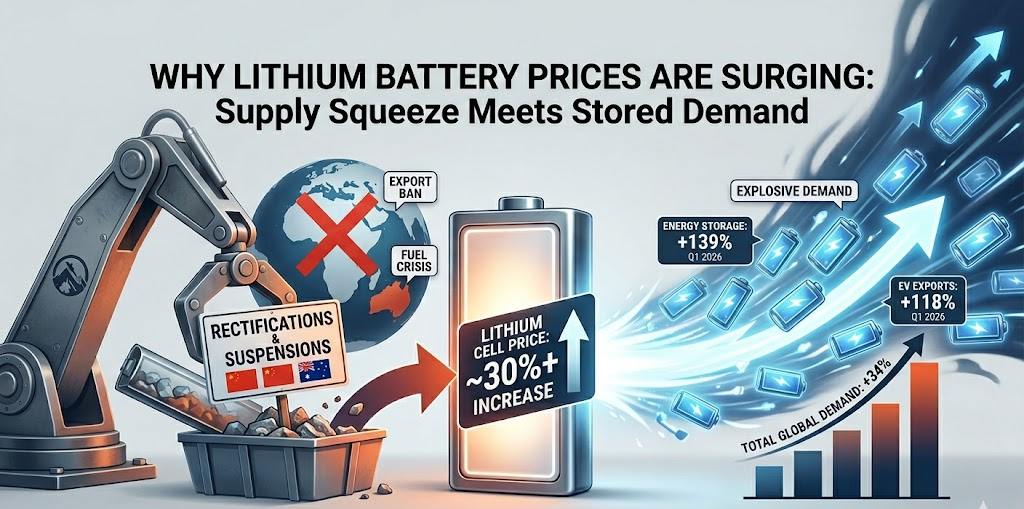
The current market is facing a perfect storm of supply bottlenecks across three major global lithium hubs:
1. Mining Rectifications in Yichun, China: Eight lithium-related mining rights in Yichun, Jiangxi Province—accounting for about 6% of global supply (approx. 200,000 tons of LCE annually)—have entered a substantive rectification phase. Four major kaolin mines are expected to face temporary production suspensions for license renewals in May 2026 to change their main mineral designation to "lithium mica". This regulatory shift makes short-term production resumption extremely difficult; notably, CATL's Jianxiawo mine has remained suspended since August 2025.
2. Zimbabwe's Lithium Export Ban: Since February 25, 2026, Zimbabwe has completely suspended all exports of raw ore and lithium concentrate. Generating about 7% of global supply (124,000 tons LCE/year) and supplying 15% of China's spodumene imports, this ban creates a significant market gap. Although export quotas were issued in April, the standard 3-6 month shipping cycle means major deliveries will be delayed until after July, causing a substantial supply vacuum in May and June.
3. Australia's Fuel Crisis: Australia, which produces roughly 30% of the world's lithium, is currently facing a fuel crisis. With diesel inventories limited to 15-30 days and Middle East conflicts driving diesel prices up by over 50%, continuous supply chain disruptions could severely contract Australian lithium output in the short term.
As a result of these factors, Morgan Stanley has drastically lowered its 2026 global lithium supply forecast from 500,000 tons to 400,000 tons LCE, while UBS predicts a global shortage of 22,000 tons this year.
While supply tightens, global demand is surging, driven heavily by the energy storage and EV sectors.
Energy Storage: The Strongest Growth Engine
Power Batteries: A Stable Foundation
Global power battery demand is projected to grow by 23% in 2026. This is bolstered by strong New Energy Vehicle (NEV) exports, which saw 955,000 units exported in Q1 (a 118% YoY increase), rapidly depleting existing inventories. Consequently, Dongwu Securities has revised its 2026 global lithium battery demand forecast up to over 2750 GWh (+34% YoY).
This supply-demand imbalance has caused rapid price transmissions across upstream, midstream, and downstream sectors:
Currently, the market shows a divergence: futures trading is driven by "supply constraints + long-term demand," while the spot market faces the realities of production ramp-ups and sluggish trading.
While institutions predict a tight balance in Q2, industry players should closely monitor key variables: the actual arrival pace of Zimbabwean quotas, the resumption of mining in Yichun, and the downstream market's tolerance for higher prices.
The fundamental driver of this price surge is the convergence of hard supply constraints and unexpected demand in energy storage. This signals a clear turning point: the lithium battery industry has officially transitioned from a phase of overcapacity into a new cycle of tight supply and demand balance.
leave a message
Scan to Wechat :

Scan to WhatsApp :