
leave a message
If you are interested in our products and want to know more details,please leave a message here,we will reply you as soon as we can.


Since the beginning of this year, prices for fiber optic cables have surged to seven or eight times their previous levels. This unprecedented situation was initially triggered by Corning securing a $6 billion order from Meta, which immediately led to a market-wide shortage of fiber optics. Consequently, leading fiber manufacturers in China have begun implementing significant price adjustments to align with the shifting supply-demand dynamics. The core logic behind this market shift is a structural price increase fueled by a combination of "explosive demand" and "rigid supply constraints". Rather than a short-term fluctuation, this represents an industry inflection point driven by long-term trends, primarily the AI computing power revolution.
Here is a detailed breakdown of the key factors driving this historic shift:

The primary catalyst for this surge comes from the unprecedented requirements of next-generation digital networks.
AI Computing Infrastructure: The construction of AI data centers requires massive bandwidth. Because of the high-frequency data exchange required between GPU clusters, a single hyperscale AI data center consumes 3 to 5 times the fiber of a traditional data center, and in some scenarios, it even reaches 5 to 10 times the standard volume. The annual global demand for data center fiber optics is expected to reach 880 million core kilometers, as adoption scales from 5% in 2024 to 30% in 2027.
National Projects and Telecom Infrastructure: Initiatives like the "Eastern Data Processing and Western Computing" national network project have heavily driven the demand for low-loss special optical fibers, such as G.654.E. Furthermore, deep 5G/6G coverage, 5G fronthaul/midhaul networks, and 10 Gigabit fiber-to-the-home (FTTH) continue to drive traditional communication demand across the broader telecom infrastructure.
Emerging Application Scenarios: New markets are rapidly expanding. For instance, military fiber-optic guided unmanned aerial vehicles (such as loitering munitions) consume non-recoverable fiber optic cables, causing global annual demand in this sector to jump from 50 million core kilometers in 2025 to 80 million core kilometers in 2026. The industrial Internet, automotive fiber optics, and aerospace sectors are also opening up vast new markets.
While demand skyrockets across multiple sectors, the industry is simultaneously hitting severe production bottlenecks.
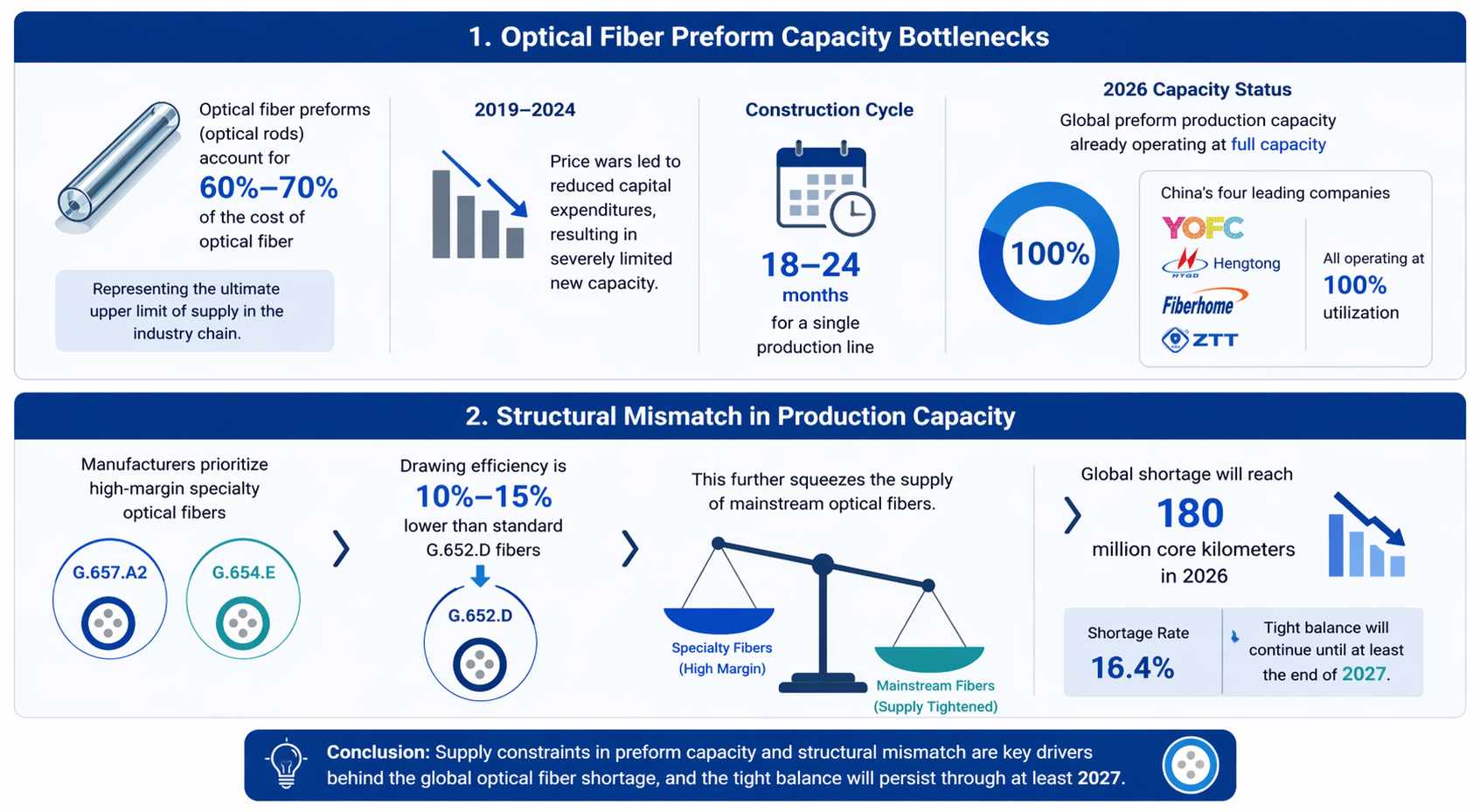
Optical Fiber Preform Capacity Bottlenecks: Optical fiber preforms (also known as optical rods) account for 60%–70% of the cost of optical fiber, representing the ultimate upper limit of supply in the industry chain. Because the industry reduced capital expenditures due to price wars from 2019 to 2024, new capacity is severely limited; the construction cycle for a single production line takes 18 to 24 months. Consequently, in 2026, global preform production capacity was already operating at full capacity, with China's four leading companies (YOFC, Hengtong, Fiberhome, and ZTT) all operating at 100% utilization.
Structural Mismatch in Production Capacity: Manufacturers prioritize the production of high-margin specialty optical fibers (such as G.657.A2 and G.654.E). However, their drawing efficiency is 10%–15% lower than that of standard G.652.D fibers, which further squeezes the supply of mainstream optical fibers. Ultimately, the global shortage will reach 180 million core kilometers in 2026, representing a shortage rate of 16.4%, and this tight balance will continue until at least the end of 2027.
This extreme supply-demand imbalance is now directly impacting procurement costs and market valuations.
Institutions generally believe that this round of price increases will continue until 2027, with the fastest profit growth expected in Q1-Q3 of 2026.
Conditions for Price Regression: Prices may fall if AI demand slows down or if optical fiber preform production capacity expands beyond expectations. However, current technological upgrades and geopolitical demand provide strong support, meaning structural shortages are unlikely to ease quickly.
This round of price increases is a long-term structural market driven by the AI computing power revolution. The core driving force is irreversible, and supply bottlenecks determine its sustainability and intensity.
leave a message
Scan to Wechat :

Scan to WhatsApp :