Network operators face an ongoing physical infrastructure problem. The deployment of 5G, edge computing nodes, and dense urban small cells requires bringing equipment closer to the end user. However, securing real estate for these sites is becoming increasingly expensive and difficult. Gone are the days when operators could easily lease large plots of land to build traditional brick-and-mortar equipment shelters.
Today, the focus is entirely on outdoor, decentralized infrastructure. Engineers must fit rectifiers, backup batteries, transmission gear, and cooling systems into heavily constrained footprints. Doing this incorrectly leads to premature battery failure, frequent maintenance truck rolls, and network downtime during peak traffic or grid outages. The core engineering conflict in these remote sites usually boils down to two factors: thermal management and spatial scalability.
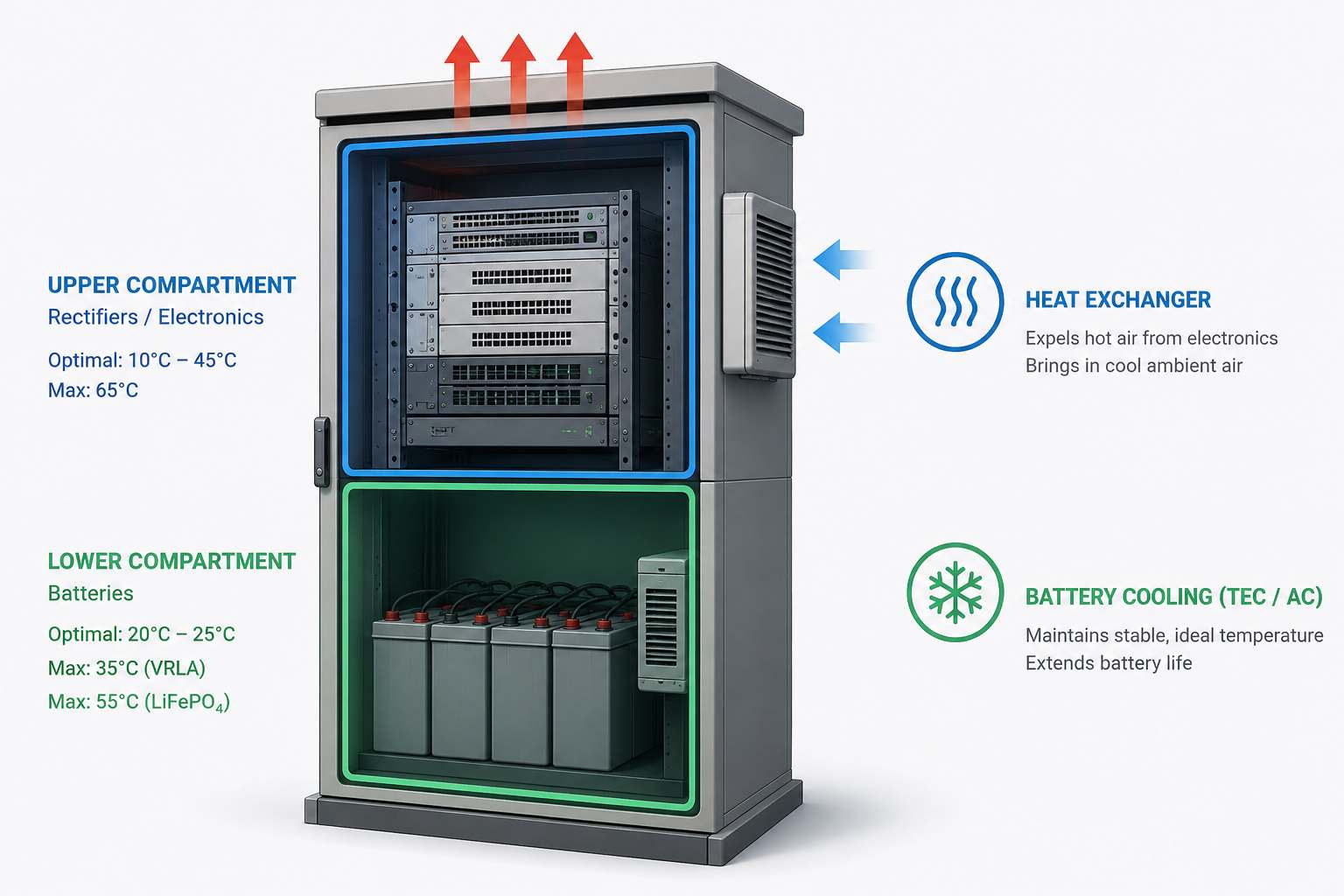
The Engineering Conflict: Electronics vs. Battery Thermals
A primary cause of site failure is improper heat management. Inside a power enclosure, the rectifiers and active telecom electronics generate significant heat during operation. These components are generally highly resilient and can continue operating safely at internal temperatures reaching 55°C to 65°C.
Backup batteries, on the other hand, are highly sensitive to heat. Standard Valve Regulated Lead Acid (VRLA) batteries have an optimal operating temperature of exactly 20°C to 25°C. For every 10°C increase above this baseline, the physical lifespan of a lead-acid battery is reduced by roughly 50%. Even modern Lithium Iron Phosphate (LiFePO4) batteries experience accelerated capacity fade when exposed to sustained high temperatures.
If you place heat-generating rectifiers in the exact same unpartitioned physical space as heat-sensitive batteries, you create an environment where the batteries will inevitably cook themselves to death. The traditional fix was to heavily air-condition the entire box, but this results in massive energy waste, as you are actively cooling electronics that do not actually require low temperatures.
| Component Type |
Optimal Operating Temp |
Maximum Tolerance |
Recommended Cooling Method |
| Telecom Rectifiers / Electronics |
10°C to 45°C |
65°C |
Heat Exchanger / Direct DC Fans |
| VRLA (Lead-Acid) Batteries |
20°C to 25°C |
35°C (Rapid life reduction) |
Active Air Conditioning / TEC |
| LiFePO4 (Lithium) Batteries |
15°C to 35°C |
55°C |
Ventilation / Active Cooling |
Implementing Segmented Thermal Zones
The most effective engineering response to this thermal conflict is physical isolation. By dividing the infrastructure into distinct physical zones, operators can apply precise climate control only where it is actually needed.
When planning a site upgrade, deploying an Outdoor Dual-Compartment Telecom Power Cabinet allows engineers to separate the equipment effectively. The upper compartment is typically dedicated to the 19-inch rack space for rectifiers, controllers, and transmission gear. This section can be cooled using a low-power DC heat exchanger. The heat exchanger simply moves internal hot air out and brings cooler ambient air in, utilizing minimal electricity.
The lower compartment is sealed off and dedicated entirely to the battery banks. Because the physical volume of this specific section is much smaller than the whole unit, it can be efficiently cooled using a specialized, low-capacity thermoelectric cooler (TEC) or a compact DC air conditioner. This targeted cooling approach drastically reduces the site's overall Power Usage Effectiveness (PUE) and cuts monthly electricity expenses while extending battery life by several years.
Addressing the Horizontal Space Constraint
Aside from temperature management, the second major hurdle is spatial capacity. A cell site built five years ago might have been perfectly sized for the local traffic at the time. However, network usage patterns change. When operators need to add new baseband units for 5G, or when local grid instability demands a larger backup battery bank for extended autonomous operation, the existing infrastructure runs out of physical space.
Expanding the site horizontally is often impossible. Rooftop lease agreements are calculated per square meter. Ground-level street sites are restricted by municipal zoning laws and sidewalks. If you cannot build outward, you must build upward.
For locations where the concrete pad cannot be expanded, utilizing a Stackable 48VDC Telecom Power Cabinet offers a massive operational advantage. These systems are designed with reinforced structural framing that allows a secondary unit to be securely mounted directly on top of the base unit. This modular approach allows an operator to double the site's power output or battery backup capacity without renegotiating the land lease or pouring new concrete foundations. The modular design also simplifies installation logistics, as technicians can transport lighter, smaller individual units to a rooftop via standard service elevators instead of requiring heavy cranes.
Managing High-Capacity Hub Sites
While stackable and dual-compartment designs are excellent for standard access nodes and edge sites, major aggregation hubs require a different level of infrastructure. These core sites handle massive amounts of data traffic routing from hundreds of smaller antennas. The power demand here is not just 100A or 200A; these sites frequently push requirements up to 1000A.
For these macro applications, patching together multiple smaller systems can lead to complex wiring, point-of-failure risks, and difficult maintenance protocols. Instead, deploying a comprehensive Telecom Power System Cabinet Solution streamlines the architecture. These high-capacity enclosures are pre-integrated at the factory. They come equipped with high-density rectifier shelves, advanced power monitoring controllers, heavy-duty busbars, and extensive DC distribution breaker panels.
The value of a pre-integrated, high-capacity system lies in standardizing the deployment. When technicians arrive at the site, they are not spending days cutting cables and configuring separate components. The entire unit is shipped as a ready-to-deploy node. This plug-and-play methodology reduces on-site labor costs, minimizes human error during installation, and accelerates the time-to-market for new network sectors.
| Deployment Metric |
Legacy Indoor Equipment Shelter |
Modern Outdoor Cabinet Infrastructure |
| Site Footprint Requirement |
10 to 15 square meters |
1 to 3 square meters |
| Installation Timeframe |
2 to 4 weeks (Civil works required) |
1 to 3 days (Pre-assembled) |
| Cooling Energy Waste |
Very High (Cooling human walk-in space) |
Very Low (Precision compartmental cooling) |
| Scalability |
Limited by wall dimensions |
High (Vertical stacking capable) |
Physical Security in Remote Environments
Moving infrastructure from locked indoor rooms to outdoor streets and remote rural areas introduces significant security risks. Copper theft and battery vandalism remain serious issues for network operators worldwide. The financial loss of stolen batteries is compounded by the severe revenue loss caused by a site going dark.
Modern enclosures mitigate these threats through advanced mechanical engineering. Unlike standard IT racks, purpose-built outdoor systems feature hidden internal hinges that cannot be cut with bolt cutters or angle grinders. The doors utilize multi-point locking mechanisms that secure the top, middle, and bottom of the frame simultaneously. Furthermore, the outer panels are constructed from double-walled galvanized steel or aluminum, providing both thermal insulation and high resistance to physical impact.
Smart locking systems are also replacing physical keys. Technicians access the hardware using remote Bluetooth clearance or temporary PIN codes generated by the network operations center. This creates a digital audit trail of exactly who opened the equipment, and at what time, virtually eliminating insider theft and unauthorized maintenance adjustments.
Aligning your infrastructure choices with the exact realities of the deployment environment dictates long-term network profitability. Whether it is minimizing the footprint through vertical expansion, separating thermal zones to extend battery life, or deploying factory-integrated setups for massive hubs, the physical enclosure is no longer just a metal box. It is the active foundation that keeps the network running reliably under adverse conditions.